Discover the book by Pauline Méliès: "Georges Méliès and his family tell his stories»
What you'll find in this book ...
The grave of Georges Méliès is currently undergoing
restoration after being damaged
Repairs are scheduled to be completed by the end of June 2025 …
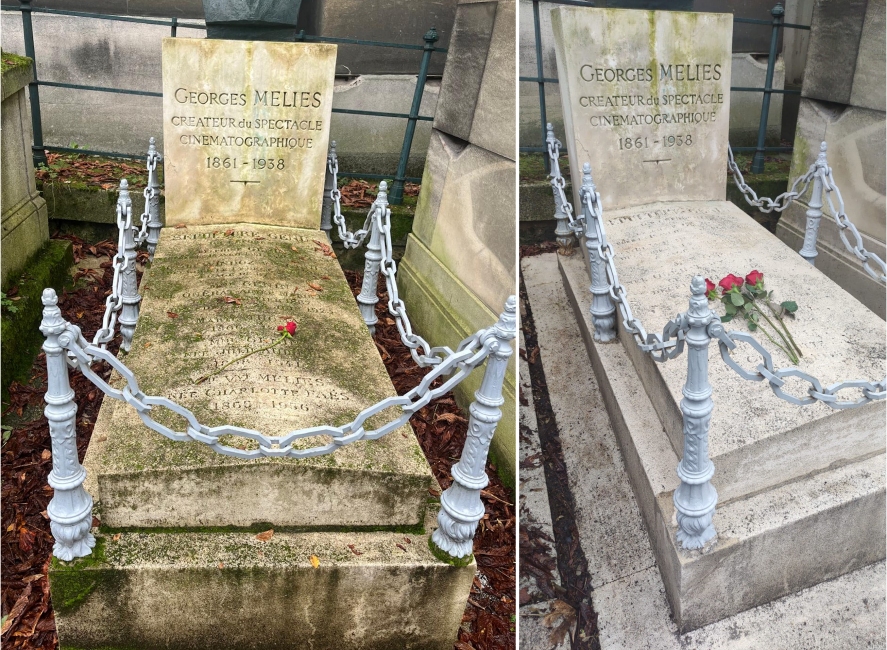
The pylon to the left of the stele was unsealed. We decided to have both pylons sent to the foundry.
A notched spike, over 15 centimetres long, will be welded into the lower section — the part that fits into the headstone. The pylons and chains will be stripped of their existing paint, metallised for optimal resistance to oxidation, and repainted in the colour you see today (RAL 7100).
On 17 May, Georges Méliès' grave appeared as follows.
The support on the front of the tombstone bears a bilingual text (French and English), inviting you to scan a QR code that links to...
the very page you are reading.


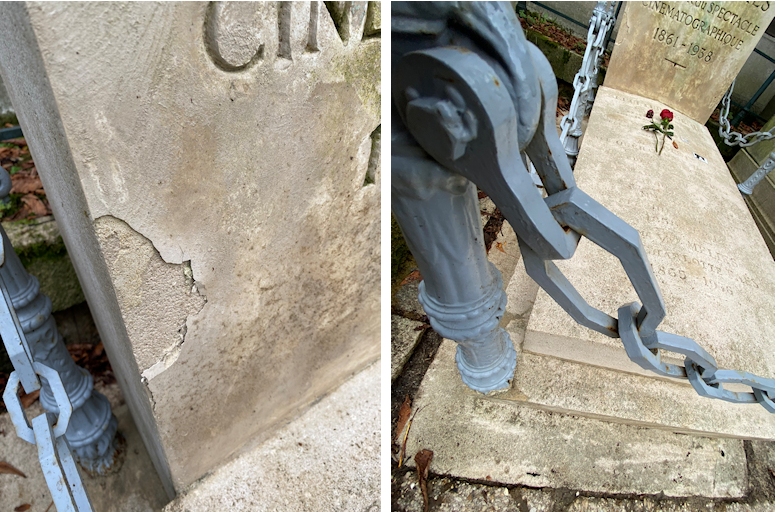
The photo below shows the left-hand corner in 2012 and again in 2022 after restoration. In 2012, there was already a double crack, clearly visible along the diagonal of the corner. The photo on the right shows the fine line between the tombstone (below) and the repair work supporting the pylon. Inside this corner are anchor rods designed to hold it securely in place. There is also a layer of cement between the base of the pylon and the gravestone. The restorers opted for this layer because the pylon on the right has a similar one.
It is likely that we will not include this layer when the pylon is returned to its original position...


The front left-hand corner of the headstone will undergo a stone graft. This is illustrated in the photo on the left, annotated by the masonry company. The photo on the right shows the current state of this corner (as of late May 2025).


Discover the book by Pauline Méliès: "Georges Méliès and his family tell his stories»
What you'll find in this book ...
Careful cleaning and restoration work on the stele was carried out at the end of March 2025.
At the end of March, we visited our grandfather’s grave several times. After a thorough dusting, we carefully sprayed the stele ourselves with the biocide (Dalep 2100).
We carefully stored the loosened pylon and the chains. We also placed a small bilingual label with a QR code that links to the very page you are reading now.
Georges Méliès' grave has now been treated with a water-repellent biocide. Apart from the iron elements (pylons and chains), the tomb is in excellent condition.
At the end of March, we also had all the estimates for the repairs reviewed and approved.


Inspection of the damage on 21 January 2025
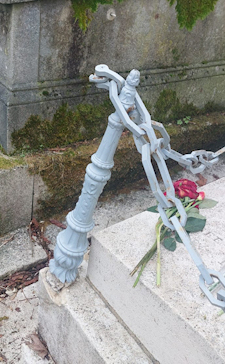
On 21 January 2025, Pauline Méliès visited the grave of Georges Méliès and was shocked to discover that it had been seriously damaged. The left-hand pylon was loose and leaning dangerously; the front chain had detached, and someone had apparently attempted to put everything back in place... as best they could.
Several specialists — ironworkers, stonemasons, and professionals in the conservation of historical monuments — were consulted.
One likely scenario is that someone leaned on the post or chain, possibly to take a selfie with the bust of Méliès in the background. The eyelet holding the chain gave way, probably due to an internal weakness in the fixing screw combined with corrosion.
The result was disastrous.
The photo below shows the tomb in perfect condition on 12 December 2024, and again on 21 January 2025.


Discover the book by Pauline Méliès: "Georges Méliès and his family tell his stories»
What you'll find in this book ...
Application of Dalep 2100 to the stele on 12 December 2024
After careful analysis of the stele, we decided to treat it with Dalep 2100. During the 2019 restoration, the stele had been coated with a sacrificial plaster. The restorers were unable to completely remove the verdigris that the stone had absorbed over several decades. This coating is non-destructive and two to three millimetres thick. Salts can crystallise between the plaster and the stone — especially near the base and along the edges — gradually pushing the plaster away and causing it to detach.
The maintenance work took only a few hours: Dalep 2100 was sprayed on, followed by a two-hour waiting period to allow the product to act fully. Gentle brushing was then carried out to remove much of the lichen and algae that had been destroyed.
The operation was initially planned for early December so that Georges Méliès’ grave would look splendid for 8 December. Unfortunately, heavy rain fell between the 5th and the 8th, making it necessary to postpone the final stage of the treatment. On 12 and 13 December, not a single drop of rain fell in Paris — an ideal window for this type of maintenance. Over the following two months, it became clear that the product had not been used correctly.
The photos taken on 12 December already raised doubts as to whether the product had been properly applied to the stele.


Dalep 2100 treatment carried out on 17 and 26 October 2024
The product used is a professional-grade fungicide that permanently eliminates all micro-organisms, lichens, algae, fungi, and spores. It is also water-repellent, making the surface waterproof and significantly extending the effectiveness of the treatment.
The product complies with the standards required by France’s Monuments Historiques authority.
We had originally planned to carry out the maintenance work with this product in September. However, September and the first half of October were very rainy. The treatment was finally carried out on 17 October. The company in charge of the work observed that the plaster on the lower right-hand section of the stele was beginning to detach. As a precaution, only the headstone was treated with Dalep 2100 — the stele itself was left untreated. Brushing to remove lichen and algae residues was performed on Saturday, 26 October.
The three photos below show the results. As you can see, the stele — the vertical section bearing the four lines of text — was not treated.


A Brief History of the Grave
of Georges Méliès
at Père Lachaise Cemetery
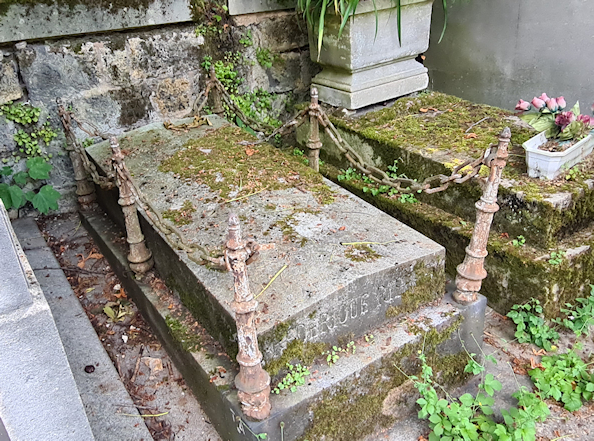
We found at Père Lachaise a grave in very poor condition, an exact replica of the one Eugénie had installed: same slab, same limestone, same pylons and chains. (see photo opposite)
Georges Méliès’s grave was, like the one you see, a simple slab of Euville limestone, put in place by Eugénie Génin on a perpetual concession she had acquired in 1881 for her mother. Eugénie was only 14 years old at the time.
In 1954, Fanny, second wife of Georges Méliès, commissioned a bronze bust from the Italian sculptor and founder Renato Carvillani (1896–1972).
Dr Malthête, husband of Madeleine (Georges’s granddaughter), donated the stele intended to hold the bust.
The inauguration took place in December 1954.
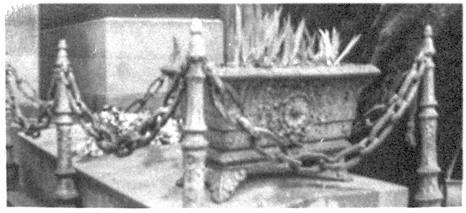
The Magician Artists quickly offered
a large and heavy metal basket.
Unfortunately, it was stolen, as were the chains.
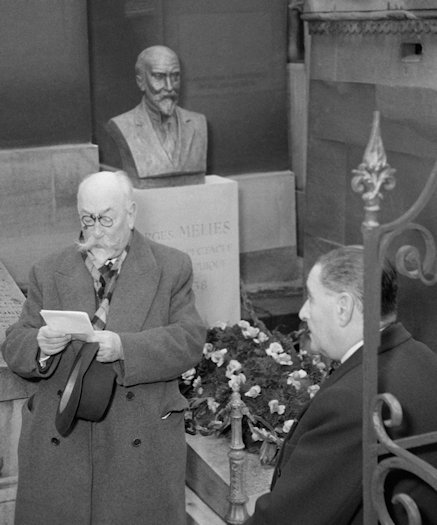

Time goes by ...
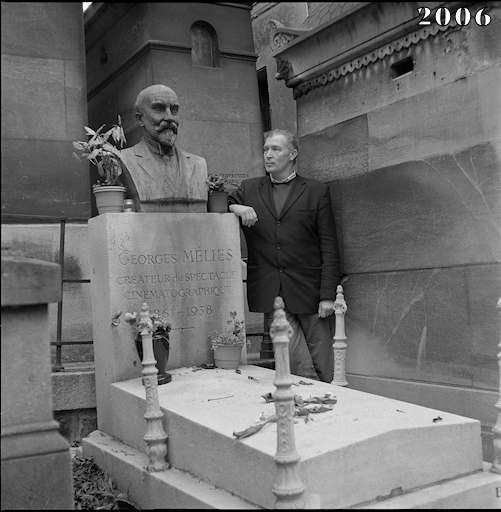

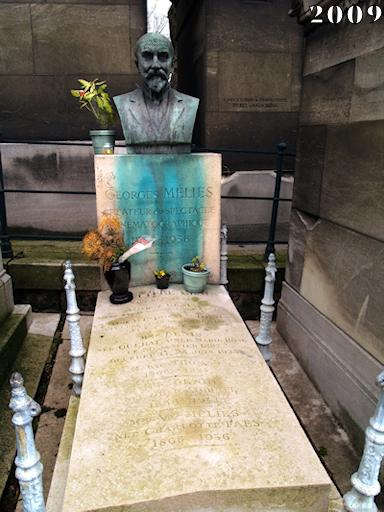

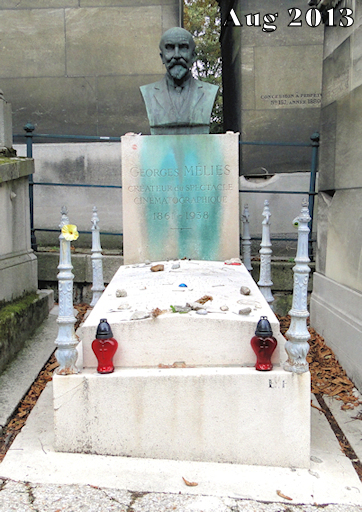
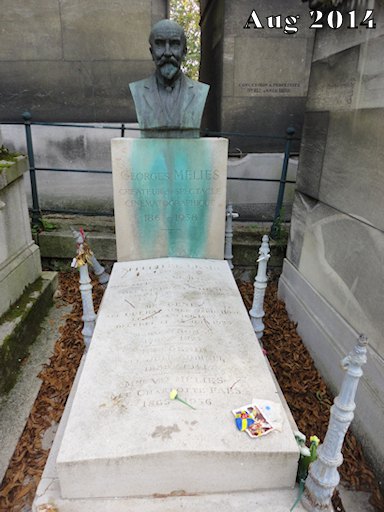
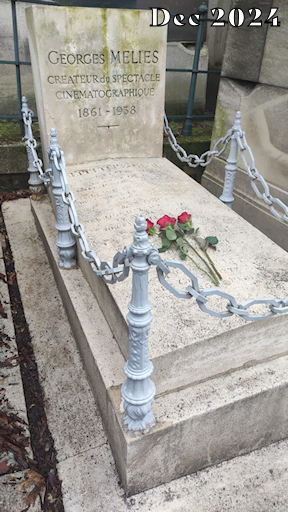
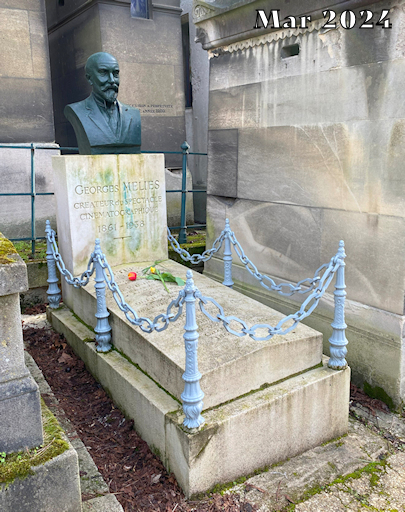

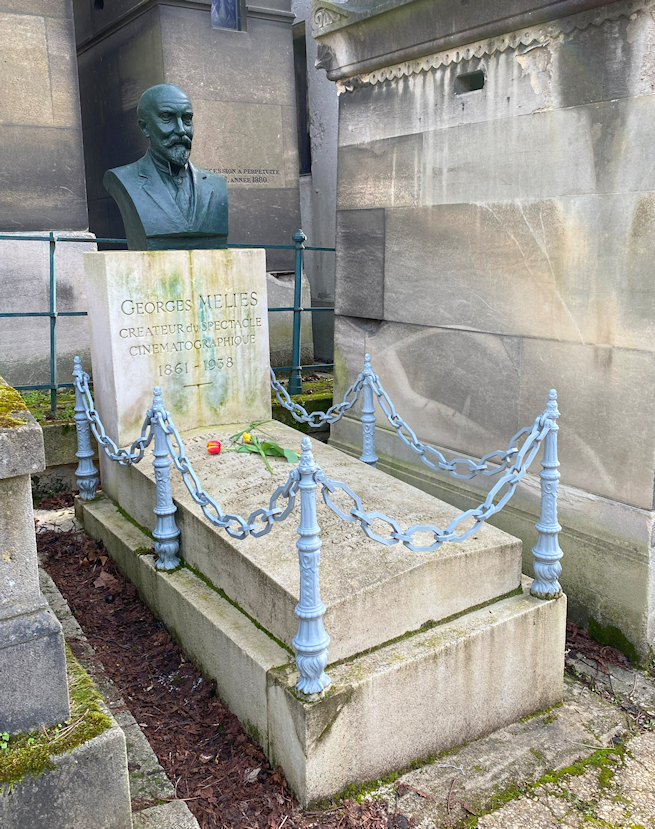
The Restoration (2019 – 2022)
In spring 2019, Pauline Méliès, great-great-granddaughter of Georges, launched a crowdfunding campaign to restore her ancestor’s grave.
Nearly 700 donors helped raise a little over €40,000.
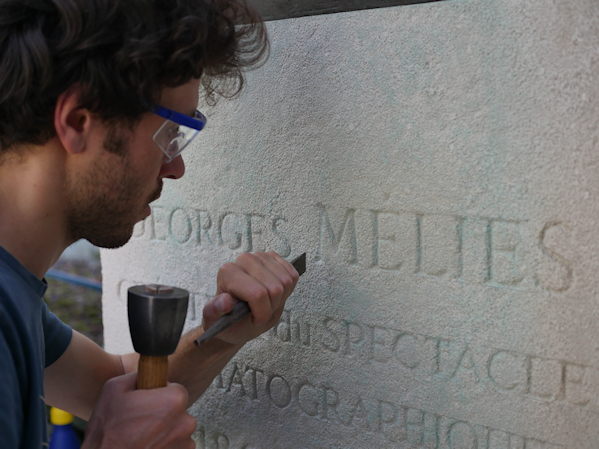
This financial success made it possible to fund not only the restoration, but also the complete re-engraving of the inscriptions on the grave and the stele.
All legal heirs naturally gave their consent.


The Emergence of New Concerns
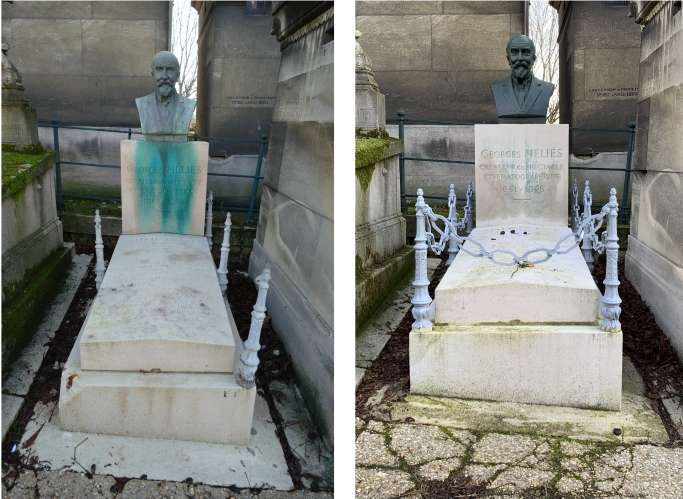
In March 2024, biological deposits (mosses and lichens) began to appear on the grave.
This was anticipated, as this area of the cemetery, very shaded and damp, encourages their growth.
The coating applied to the stele is generally resistant to the resurgence of verdigris, although a few traces are reappearing.
This is a problem that will need to be monitored in the coming years.
On the other hand, the treatment of the bust has been very effective: the verdigris streaks that once covered the stele have been completely removed.
This is a very satisfactory result.
The Biocidal Treatment
Père Lachaise Cemetery prohibits any aggressive chemical treatment of monuments (statues, bronzes, ironwork, stone, etc.).
Only environmentally friendly treatments are permitted.
Biocidal products fall into this category.
Initially scheduled for October, the treatment could only be carried out in mid-December due to heavy rainfall, which rendered any intervention ineffective.
Photographs taken in October (when the grave was soaked) and in December (after a few dry days) show the change.
The biocidal treatment of the stele could not be carried out: the contractor observed detachment of the coating on the lower right-hand side.
The left-hand corner pylon was still perfectly in place at that time.


The Damage
On 21 January 2025, Pauline Méliès visited the grave and, to her dismay, discovered significant damage:
The left-hand pylon had come loose, was leaning dangerously, the front chain had detached, and someone had tried to put everything back… as best they could.
Several specialists (a metalworker, a stonemason, professionals in historic monuments, etc.) were consulted.
A likely scenario is that someone leaned on the post or the chain — for example, to take a selfie with Méliès’s bust in the background.
The eyelet holding the chain broke, most likely due to an internal weakness in the fixing screw and corrosion.
The result is disastrous.
The Restoration Work
As of today (end of March 2025), all repair quotes have been approved.
The left-hand corner of the tombstone, which has been cracked for a long time, will receive a stone graft.
The anchoring of the pylon there will be significantly reinforced.
The chains will be removed, treated (metal-coated), and reinstalled.
The broken pylon, along with its eyelet, will be remade, reinforced, welded, metal-coated, and put back in place.
Pylons and chains will be treated with anti-corrosion coating and painted grey.
Work will begin in the course of April, with completion hoped for by the end of June.
By checking this page, you will be regularly updated on the progress of the work.
Thank you for your interest in this memorial site
dedicated to Georges Méliès.